Craft Commerce 5 · works with Postie
Freight carriers price pallets. Give them pallets.
An LTL carrier does not price forty cartons. It prices the two pallets those cartons are strapped to. But Postie hands the carrier its cartons, because that is what a box packer produces — so the carrier either refuses, rates forty parcels, or returns a number with no relationship to the bill that turns up three weeks later. Palletizr builds the pallets your warehouse would actually build, and quotes those.

Finds the row blocking misses
How many cases fit a deck is not a division sum — it is the pallet-loading problem, and it decides how many pallets a shipment needs. Most shipping software lays every case the same way round and takes the better of two grids. Palletizr searches guillotine cuts for the interlocked patterns a warehouse builds by hand.
A 500 × 300 case on a 1200 × 800 Euro pallet

  Block loading        4 per layer     62.5% of the deck
  Optimised            6 per layer     93.8% of the deck

On a 24-case order that is the difference between

  2 pallets   8.11 lb/ft³   class 110
  1 pallet   11.66 lb/ft³   class 92.5

{# Both figures come out of the test suite, not marketing. #}Features
A real load builder, the freight facts a carrier actually asks for, and an integration that changes nothing about how Postie works.
Layer by layer, like a person
Flat courses bottom to top, heaviest first, with nothing stacked on a carton that says not to — not free-space 3D packing that produces an arrangement nobody can strap and wrap.
- Mixed layers: the dominant case takes the deck, the next size fills what it leaves
- A load that cannot be built is not a better answer for being tighter
Standard, custom and several
Twelve standard footprints seeded in your own units — GMA, EPAL 1 to 6, the Asia T11, the Australian square, half and quarter pallets — plus anything else you build on.
- Seeding is idempotent, so corrections you make by hand survive an upgrade
- Deck, pallet height, empty weight, rated load, layer cap and overhang are all yours
Rules that decide, not accumulate
Read top to bottom, first decisive rule wins. Palletizing is one decision about one shipment, and summing partial answers from four rules would produce a plan no warehouse could follow.
- Require gates it, Never refuses it, Palletize settles it
- Weight, cube, carton count, destination, postal code, shipping category, carrier — and a full Craft order condition
Freight class from density
Gross weight over gross cube — pallet and air included — against the NMFTA density scale. A tighter pattern is denser freight, and denser freight is a cheaper class.
- Per-pallet overrides and NMFC codes for commodities classed on something other than density
- Fifteen carriers' handling-unit limits, checked and warned about rather than assumed
Slots into Postie, changes nothing
It attaches where Postie has finished packing and has not yet asked anybody for a price, and replaces the carton list with a pallet list. No changes to Postie, and it works without Postie too.
- Carton tare is carried across exactly — a pallet rebuilt from items alone silently loses it
- Parcel providers are left alone by default, and a failure leaves Postie's own packing standing
Shows its working
A simulator that draws every layer looking down at the deck, a console build sheet for any real order, and every rule that was evaluated with the reason it did or did not apply.
- The simulator calls the same load builder a checkout does, so it cannot disagree with one
- The order's shipping adjustment carries the pallet count, class, linear feet and every warning
Palletizr in the control panel
Real screens from a Craft 5 install running Commerce: the pallet standards you actually build on, and a simulator that shows how a given order would be loaded.
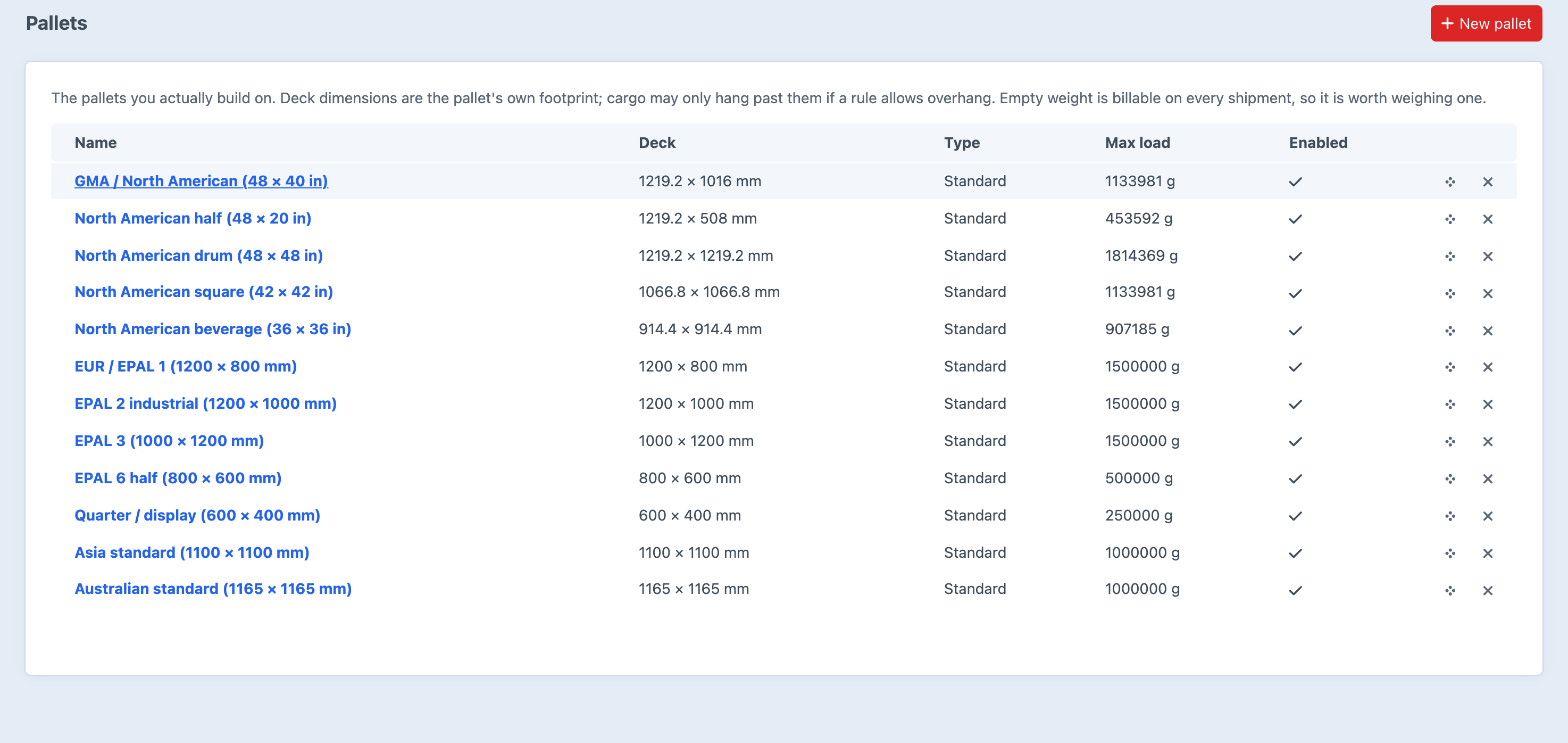
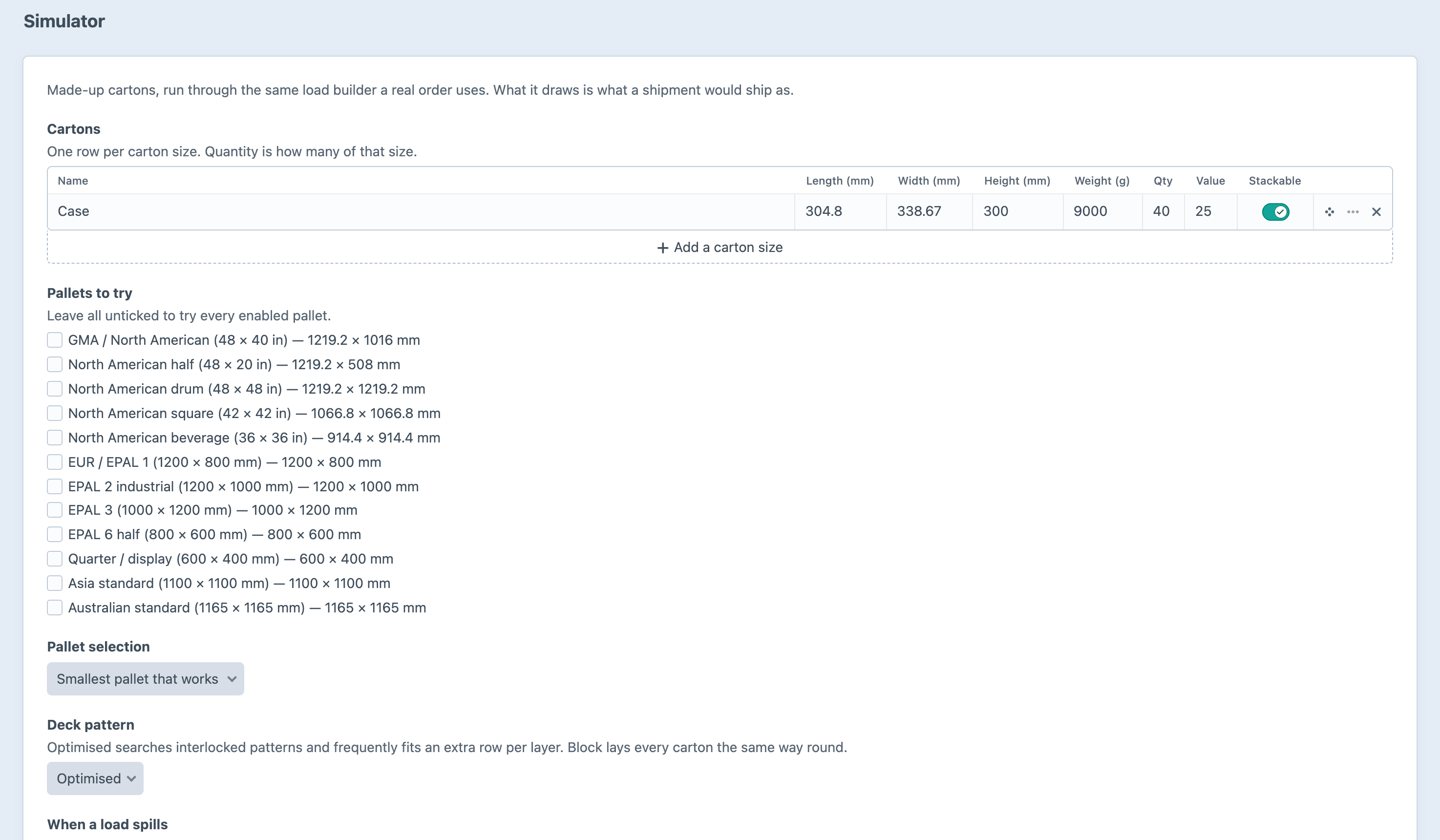
Screenshots from a live install, not mockups.
Frequently Asked Questions
The questions worth answering before you install it.
No, but it is the point. Postie is what turns pallets into a live carrier quote. Without it Palletizr still builds pallets for the simulator, your templates and its own freight tariffs — there is simply no carrier to send them to.
No. Nothing palletizes until a rule says to, and palletize when no rule matches is off by default. Installing it and seeding pallets is a no-op: Postie keeps quoting exactly what it quoted yesterday.
No, and it says so. It searches patterns that can be produced by repeated straight cuts across the whole remaining area, which is a real restriction — a handful of case sizes have a best packing that is not guillotine-cuttable. It is also exactly the restriction a human loader works under: a pattern nobody can build from a stack of cases and a diagram is not worth finding.
It is the NMFTA density guideline, which is what the great majority of LTL freight is classed on and what every carrier's tariff is built around. It is not a classification. A commodity with its own NMFC item number is classed by that number regardless of what it weighs, and some are classed on stowability or liability instead. That is what a pallet's freight class override is for.
They are each carrier's general published limits, not your contract. A store with a negotiated tariff will have different numbers, which is why a violation is a warning on the load rather than a refusal to quote. What Palletizr will not do is find a violation and say nothing.
Because it has no dimensions recorded, because it fits no enabled deck, or because a rule's maximum pallet count was reached. All three are named in the load's warnings. A carton of unknown size cannot be placed, and guessing would produce a quote the carrier will not honour.
Yes, and that is why you enter it. A GMA pallet is about 34 lb and a hardwood Australian pallet about 88 lb; on a three-pallet shipment that is over a hundred pounds of billable weight that has nothing to do with what was ordered. Weigh one of yours and replace the seeded figure.
The error is logged and Postie's original packing stands. The worst case is a shipment quoted as loose cartons — which is what would have happened without the plugin.
Yes, for different services. Do not enable both for the same one, or the customer sees two prices for one shipment. The tariff is for freight nobody offers a live rate for — a negotiated rate with a regional carrier, or a flat charge per pallet.
No. Palletizr is $59 with a $49/year renewal, and everything is switched on: the optimised solver, per-class hundredweight rates, condition-builder rules, the Postie bridge, the simulator and the console. The renewal buys updates and support; the plugin keeps working if you let it lapse.
Stop quoting boxes
$59, with a $49/year renewal. One edition, everything switched on. Craft 5.3+, Commerce 5, PHP 8.2+, and Postie optional.