Lite free · Pro $99 · Craft CMS 5
A careers page, an application form and a pipeline
Hire is job listings and applications for Craft CMS. Jobs and applications are elements, so the field layouts, per-site URLs, drafts, permissions, search, trash, element index and exporter are Craft's own rather than a second implementation of each.

A careers page in one line
The listing is rendered on the server, so it works with JavaScript off, is indexable, and every filter is a link you can paste into an email. The job page needs two more calls: the application form and the structured data Google for Jobs reads.
{# The careers page: search, filters, results, pagination #}
{{ craft.hire.listing() }}

{# A job page #}
{% block head %}{{ craft.hire.schema(job) }}{% endblock %}

<h1>{{ job.title }}</h1>
<p>{{ job.locationLabel }} · {{ job.salary }} · closes {{ job.expiryDate|date('j F Y') }}</p>

{{ craft.hire.applyForm(job) }}Features
Posting the job, taking the application, and what happens after.
Jobs are elements
A field layout for the advert, per-site URI formats and templates, drafts and revisions, search, relations and the trash. The jobs index shows the reference, applications, openings, location, salary and closing date.
- Statuses: open, scheduled, closed, disabled
- Closing dates enforced when the job is read, cron or no cron
Applications are elements too
The inbox is Craft's own element index: sources per stage, sorting, keyword search across everything the candidate wrote, a bulk move-to-stage action, and Craft's exporter. An unread badge sits on the sidebar.
Filters that mean what people mean
Ticking Engineering and Design shows either; ticking Engineering and Part time shows both. OR within a group, AND across groups, with live counts next to every filter. Groups are project config; terms like a new office are content.
JobPosting that validates
An invalid posting fails silently and never appears in Google for Jobs. Hire builds the structured data itself, including both halves of a remote job and employment types checked against Google's fixed vocabulary when the job is saved.
An application form, validated on the server
Name, email, phone, CV and cover letter map onto real columns. Pro adds thirteen question types of your own. A value posted under a handle the form doesn't define is dropped, and a rejected submission comes back with the answers still filled in.
Stages that say what they mean
Each stage is still in the running, hired, or not proceeding, so a job's filled count moves by itself when somebody is hired. Every move, email and first open goes into an append-only history.
- Pro: your own stages, stage emails, ratings and notes
Emails that reach people
A confirmation to the applicant and a notification to the team, both ordinary Craft system messages. Queued by default, because a slow mail server inside the request looks to the applicant like a form that hangs.
Spam defences that cost the applicant nothing
A honeypot, a signed timestamp and a rate limit run before any CAPTCHA is considered. reCAPTCHA, hCaptcha and Turnstile are available and off by default. Every refusal except the rate limit returns the same message, so a script can't learn which check it failed.
CVs handled like personal data
Uploads are checked by extension and by detected file type, markup files are always refused, and filenames get a random prefix. CVs stream through the control panel behind a permission. Hire never picks a volume for you.
- Pro: retention that hard-deletes, CV included
- IP addresses off by default
Your own front end, same results
The built-in listing, craft.hire.results() and the JSON endpoint all make the same call, so a bespoke front end and the supplied one can never disagree. The endpoint is anonymous and CORS-open, and sorting is limited to an allow-list.
GET /hire/jobs.json?department=engineering&jobType=full-time&q=php&page=2

php craft hire/jobs/expire --dry-run          # close jobs past their closing date
php craft hire/applications/export --file=out.csv --job-id=12
php craft hire/applications/prune --days=365 --dry-runHire in the control panel
The jobs index, the applications inbox, one application in the pipeline, and the careers page it all feeds.
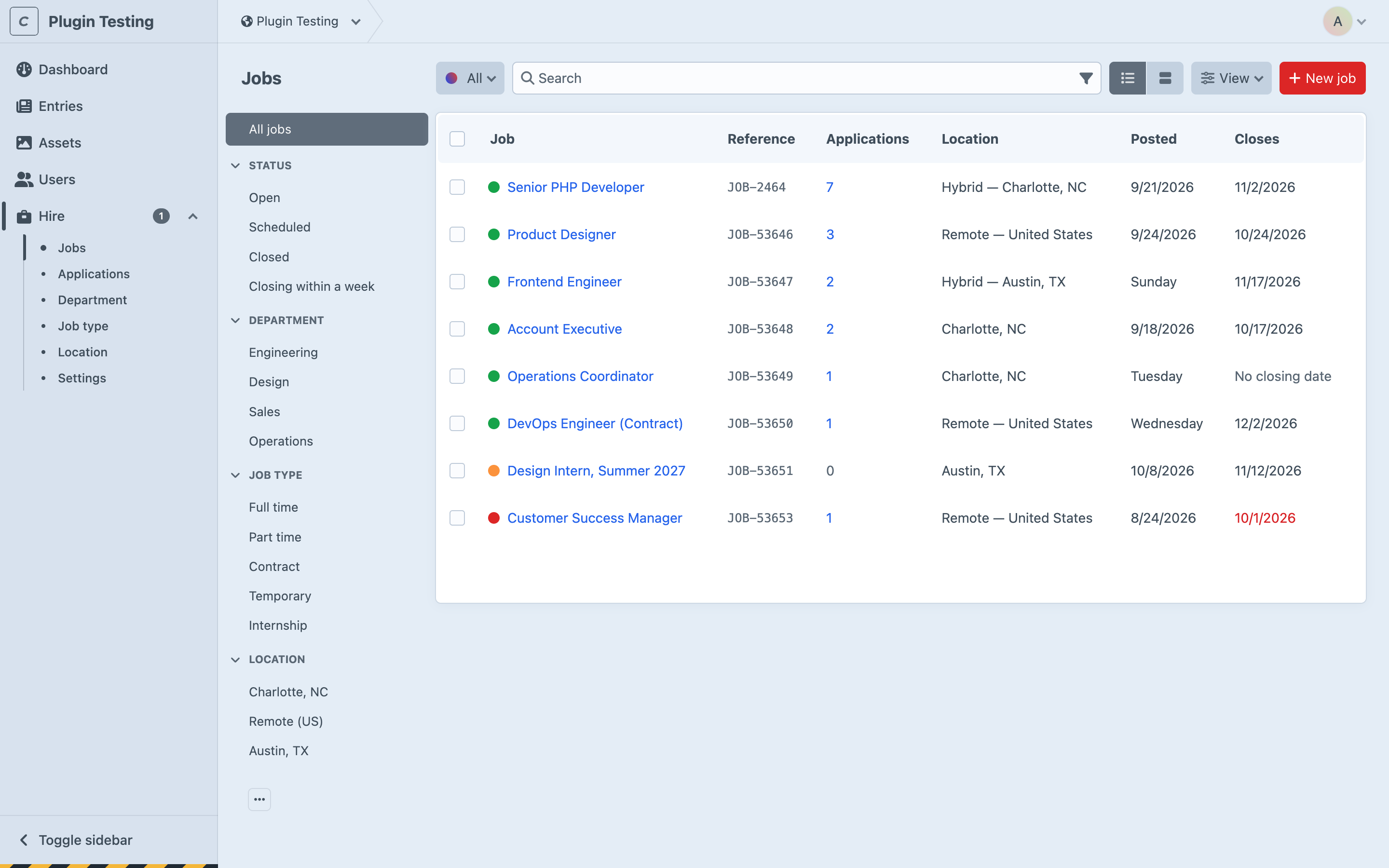
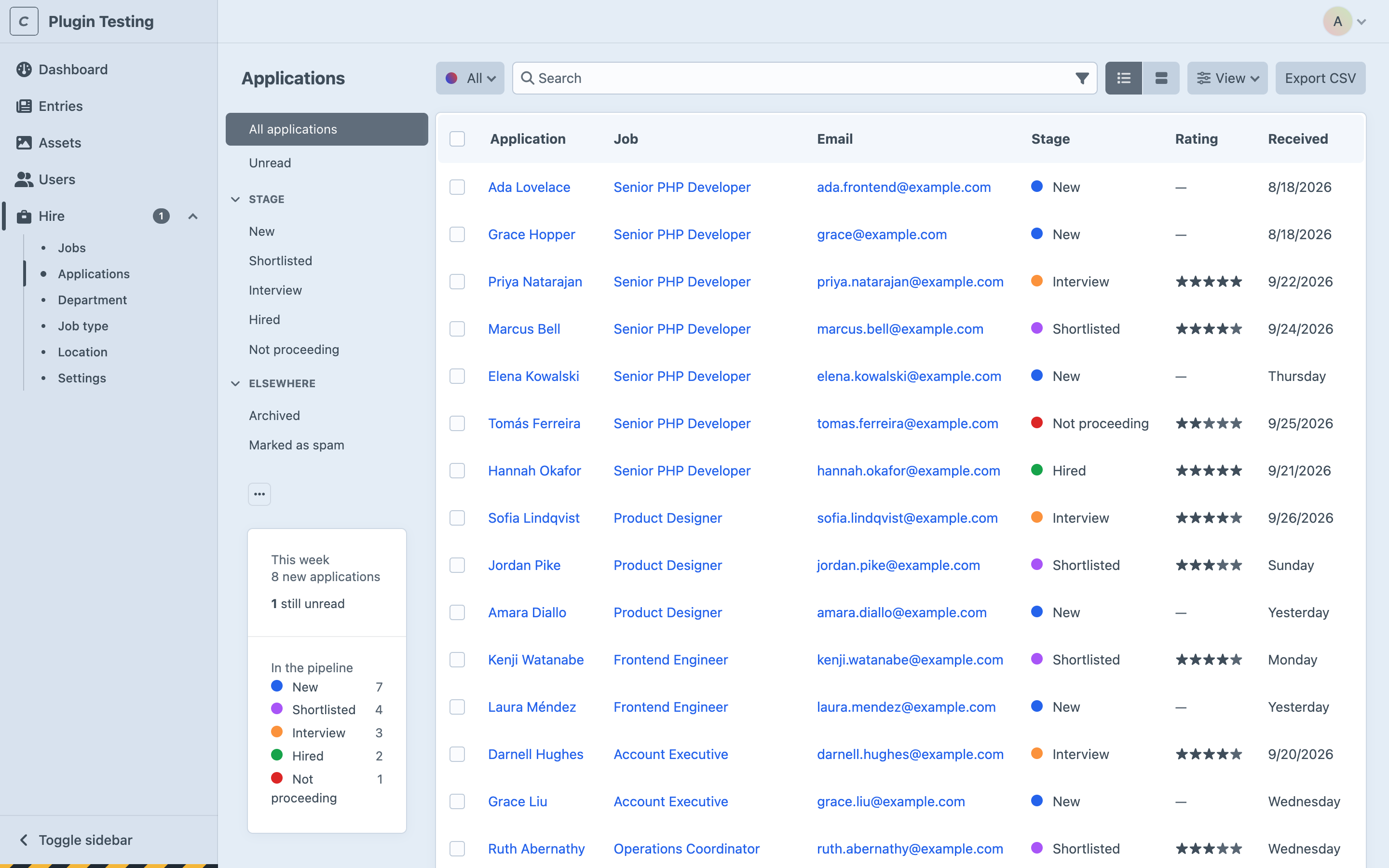
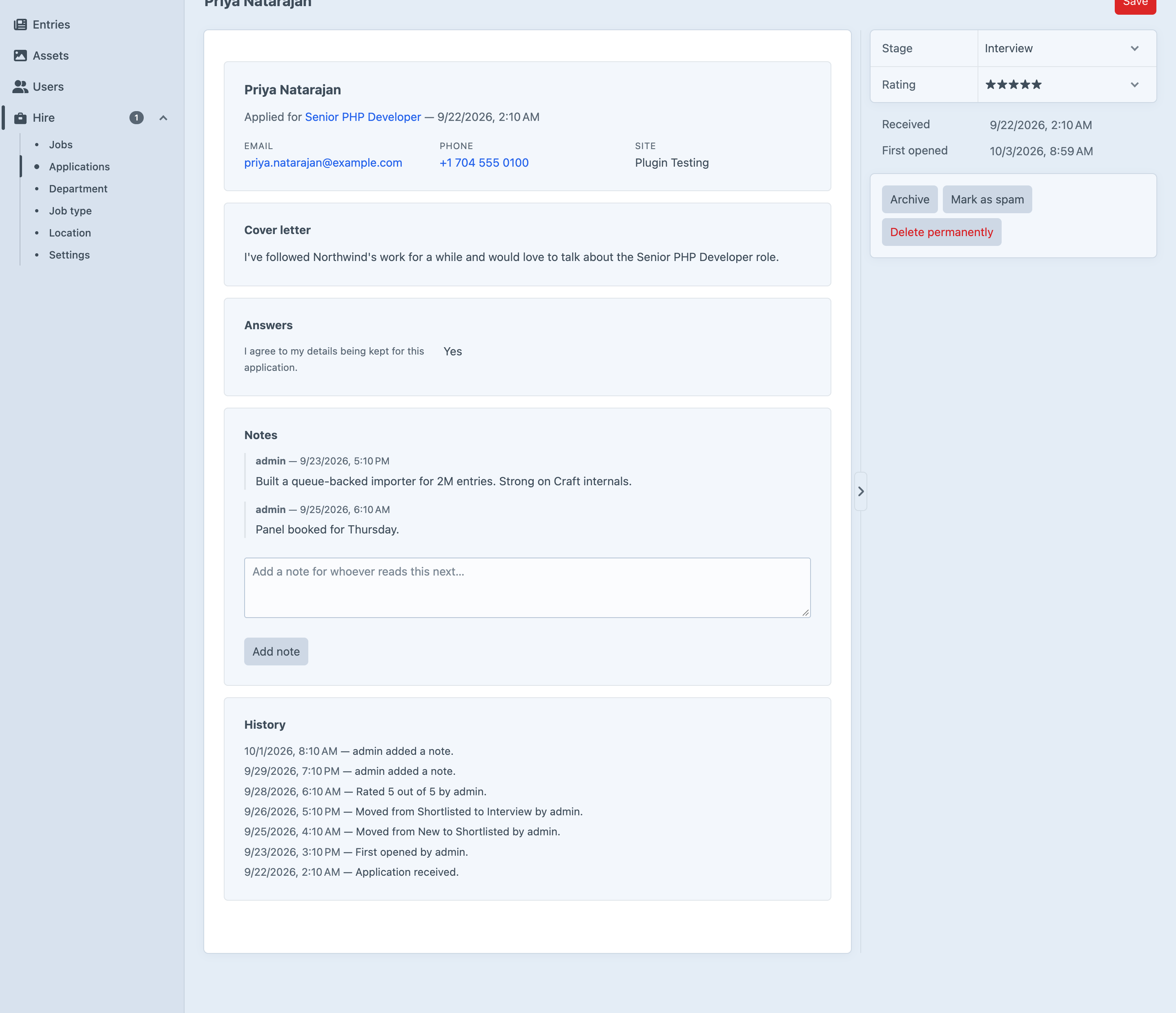
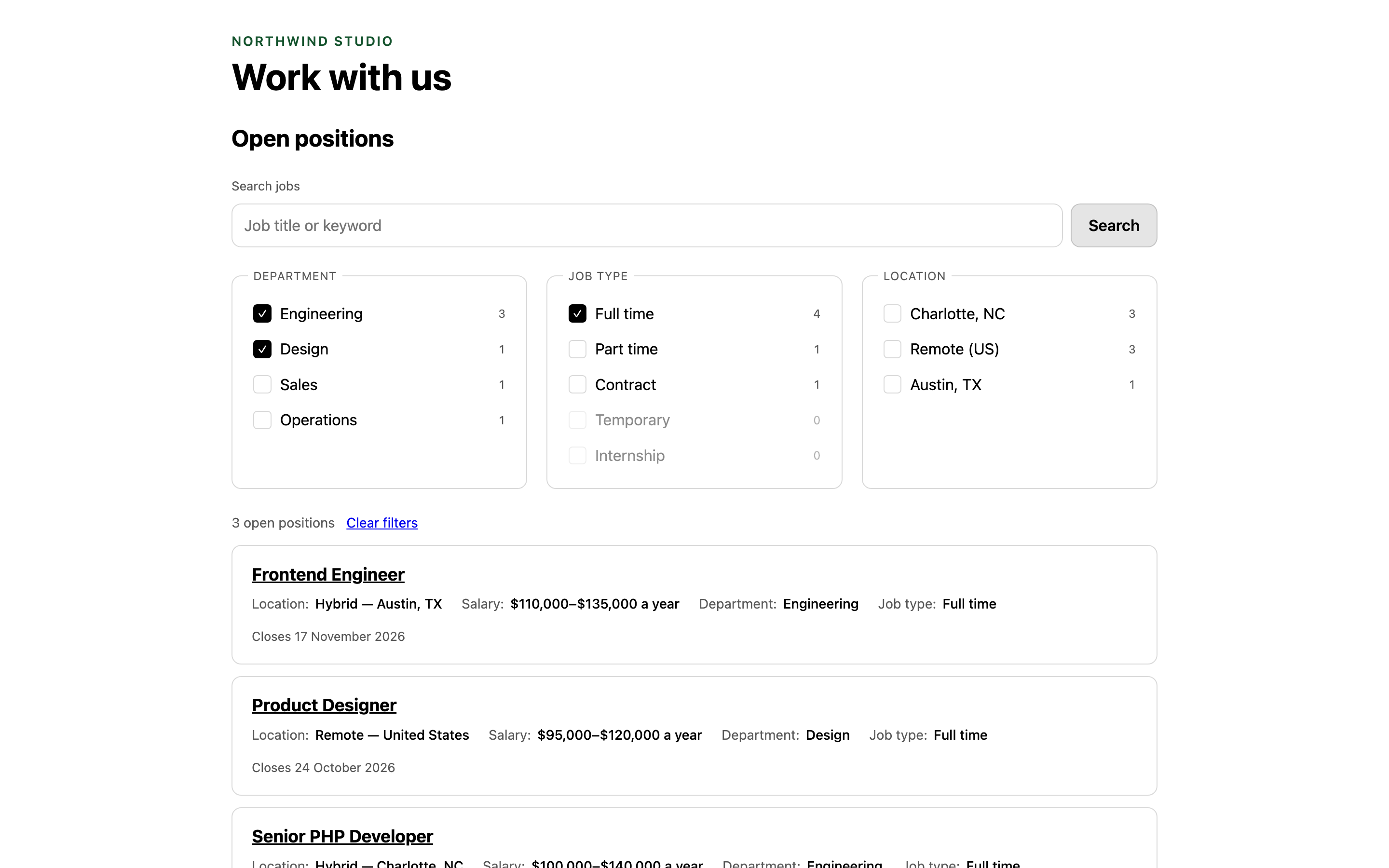
Screenshots from a live install, not mockups.
Frequently Asked Questions
Questions worth answering before you install it.
It covers the same ground: listings, filters, an application form and an applicant inbox. The difference is that Hire is Craft-native all the way down. Jobs and applications are elements, so field layouts, per-site URLs, drafts, permissions, search, relations, the trash, the element index and the exporter are Craft's own.
No. There is no limit on jobs or applications in Lite. Posting jobs, taking applications, CV uploads, both emails, CSV export, filters, the JSON endpoint and Google for Jobs are all included. Lite has one form, the four built-in stages and three specification groups.
Because a stranger fills it in. A field layout renders control-panel HTML for a trusted author, has no server-side story for an anonymous upload, and no concept of "the visitor must answer this". Applications do have a field layout, for what your team records afterwards: interview date, salary expectation.
Into the asset volume you choose. Hire never picks one for you, because the first volume on most sites is public images. Until a volume is chosen, forms can't take a CV, and the settings screen warns when the chosen volume has public URLs. Downloads go through the control panel and need the View applications permission.
They stay. The application keeps a copy of the job's title, so "who applied for the 2026 warehouse job" can still be answered after the advert is tidied away.
Yes. View applications is not nested under the jobs permissions. Publishing an advert is not the same as reading named people's CVs and employment history, and many organisations want the first without the second.
Copy any of Hire's templates into your own templates/hire/ and edit it; Hire looks for the site's copy first. Or build the page from craft.hire.results() or /hire/jobs.json.
Lite is free. Pro is $99 one-off, with an optional $79/year renewal for updates. Pro adds more than one form, questions of your own, your own pipeline stages, stage emails, ratings and notes, duplicate detection, automatic retention deletion and the applicant status page.
Craft CMS 5.3+ and PHP 8.2+. There's no build step and no runtime dependency beyond Craft.
Publish a job, then take the first application
Lite is free, with no cap on jobs or applications. Pro is $99 one-off with a $79/year renewal, and adds your own stages, stage emails, ratings and notes, more forms and questions of your own.